Hagia Sophia, Constantinople
On December 27, 537 AD, Emperor Justinian I dedicates the newly built Hagia Sophia in Constantinople: its 32-meter dome rising on pendentives in a structural feat that defines Byzantine architecture.
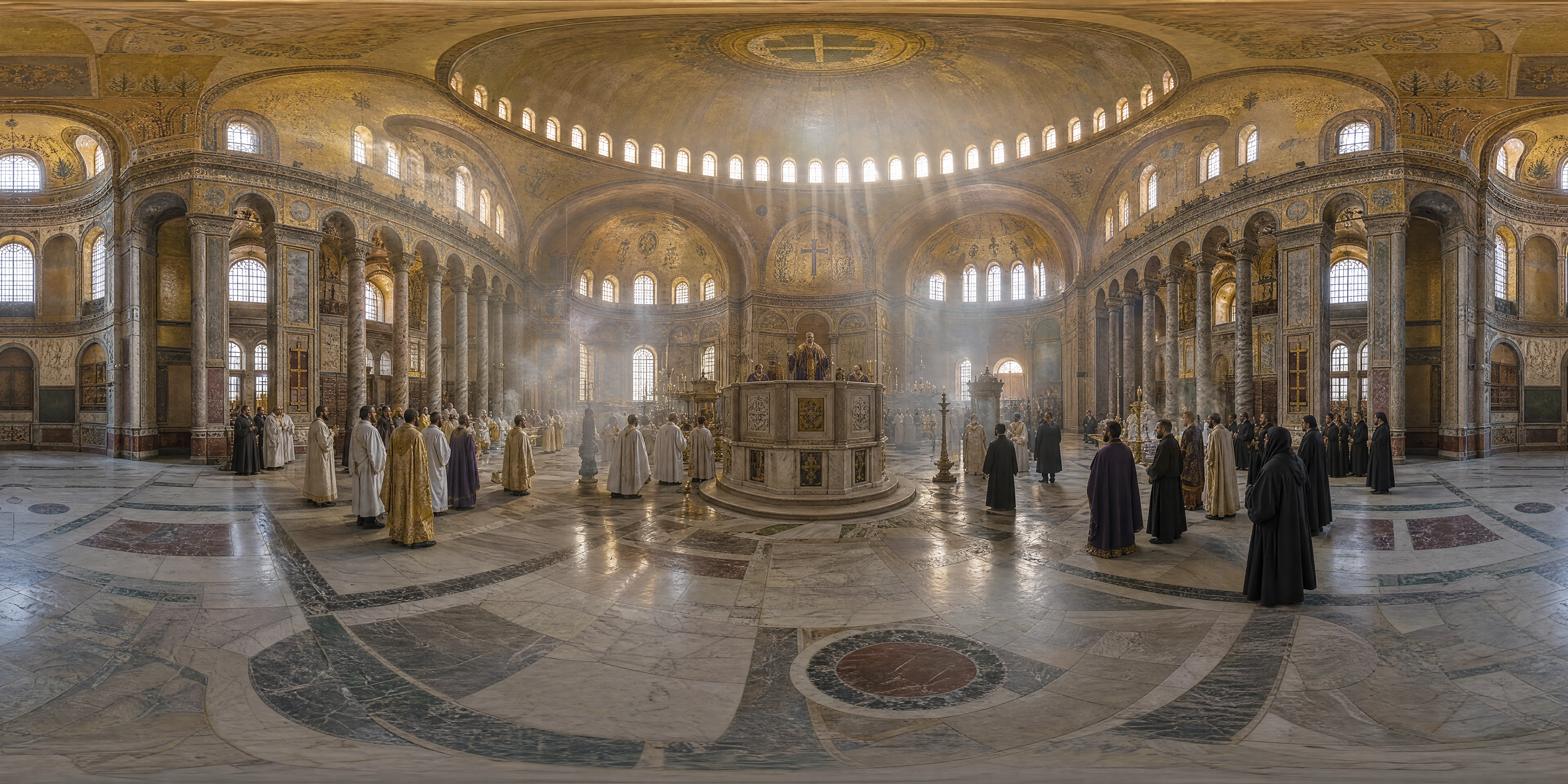
- Year
- 537
- Where
- Constantinople, Eastern Roman Empire · TR
- Era
- Medieval
- Coordinates
- 41.009, 28.980
The moment
Five years, ten months, ten thousand workers
Justinian opened Hagia Sophia on 27 December 537. Five years and ten months earlier the previous church on the site had been a heap of charcoal, burned to the ground during the Nika riots of January 532, in which mobs angry about chariot-racing politics had nearly deposed the emperor.
Within twenty days of suppressing the riot (with mass executions in the Hippodrome that killed perhaps thirty thousand people), Justinian had decided. He would replace the destroyed church with the largest building in the Christian world. He hired ten thousand labourers. He emptied the imperial treasury: 320 000 pounds of gold, by the chronicler Theophanes's account, in an era when a skilled craftsman might earn one gold solidus a month.
Two mathematicians, not architects
The men Justinian put in charge were not professional builders. Anthemius of Tralles wrote treatises on burning mirrors and conic sections. Isidore of Miletus edited the works of Archimedes. They approached the church as a geometric problem.
Their solution was a 31-metre dome resting on pendentives (the concave triangular sections that let a circular dome sit on a square base) at monumental scale for the first time in history. The dome appeared to float on a ring of forty arched windows.
It partially collapsed in 558. Isidore's nephew, the Younger Isidore, rebuilt it six metres higher to better resist earthquakes. What stands above the nave today is essentially the 562 reconstruction.
"Solomon, I have surpassed you"
The line is not in any contemporary source.
Procopius, Justinian's official chronicler, wrote a panegyric on the buildings, De Aedificiis, and quotes nothing of the kind. Paul the Silentiary recited a long encomium at the second dedication in 563 and quotes nothing of the kind. The line first appears in the ninth-century chronicle of Theophanes the Confessor, three hundred years after the event.
Whether or not Justinian said it, the meaning was right. Hagia Sophia held the title of the world's largest interior space for nine hundred and eighty-three years, until the completion of Seville Cathedral in 1520.
Mosaics nobody saw for nine centuries
The Christ Pantocrator in the dome, the Theotokos in the apse, the imperial portraits in the south gallery: none of them date from Justinian's time. The original sixth-century decoration was geometric and floral: gold-ground crosses, palmettes, guilloche borders. The figurative mosaics were added gradually between 843 (the end of Iconoclasm) and the eleventh century.
When Mehmed II converted the building to a mosque in May 1453, he faced a problem of Islamic law: figural imagery is forbidden in mosques, but destroying existing religious art is also discouraged. He compromised. The mosaics were whitewashed.
The compromise worked. Five centuries of Ottoman whitewash preserved the Byzantine mosaics beneath, unweathered, in a kind of accidental vault. When Atatürk made the building a museum in 1934 and restorers began removing the whitewash, they found the imagery exactly as it had been on the last day before the conversion.
Further reading
Tagged
- byzantine
- constantinople
- justinian
- hagia-sophia
- church
Published
See also

12th century AD
Kealakekua / Big Island, Hawaii
Around 1200 AD, a Polynesian double-hulled voyaging canoe from the Marquesas Islands makes landfall on the unpopulated Big Island of Hawaii after navigating 4,000 km of open Pacific.

1200s
Bayon temple, Angkor Thom
Around 1200 AD, a royal procession of the Khmer king Jayavarman VII winds through the Bayon temple at the heart of Angkor Thom, surrounded by the smiling stone faces that crown its 54 towers.

1350s
Great Zimbabwe
Around 1350 AD, Great Zimbabwe is the capital of a prosperous Shona kingdom controlling gold trade with the Indian Ocean: its elliptical dry-stone walls and conical tower the largest stone structure in sub-Saharan Africa before the modern era.